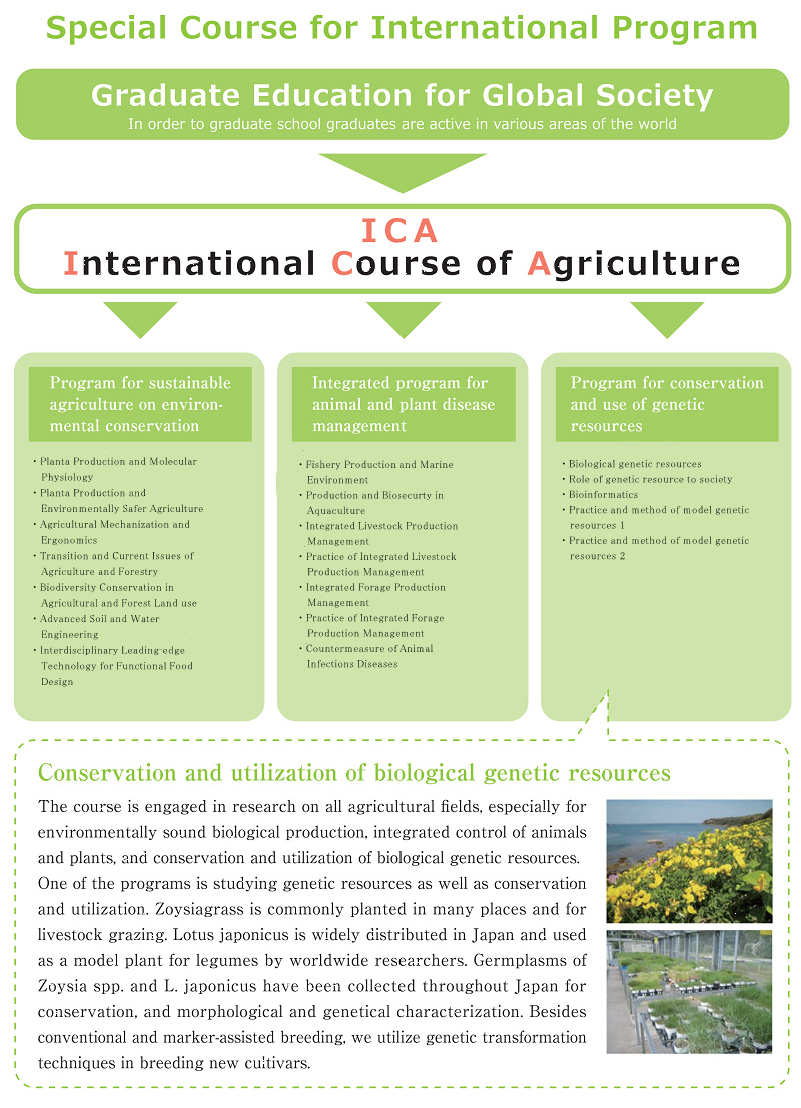
農学国際コース
Exploiting the benefits of specializing in agriculture (single-subject specialization) and considering globally emphasized issues, particularly by ASEAN nations, this course provides three types of practice programs: cross-cutting, task-pursuing, and problem-solving types. As well as implementing mutual exchange education in cooperation with overseas academic exchange partner institutions, the course aims to develop highly skilled experts and researchers who can globally contribute to exploiting and developing their diverse and advanced expertise and skills relating to agriculture. Another feature of this course is the fact that all lectures are provided in English in principle.
Admission Policy
1.Those who have undergraduate-level equivalent basic and applicative expertise related to food, environment, and resources with an international perspective and basic English skills to express and understand those fields
2.Those who are eager to play future roles at home and abroad in the fields related to environmentally sound biological production, integrated control of animals and plants, and storage and utilization of biological genetic resources
Curriculum Policy
1.Courses are offered to enable students to acquire advanced specialized knowledge and technical skills in environmentally sound biological production, integrated prevention and control of animal and plant diseases, and the conservation and utilization of biological genetic resources.
2.Courses are offered to foster students' ability to present and articulate their own ideas as highly skilled professionals.
3.Courses are offered to enable students to integrate the knowledge and skills they have acquired and apply them to solving problems and creating new value through research projects and the preparation of a master's thesis.
Diploma Policy
Students who registered for a prescribed period and acquired the attainments described below, and besides who have obtained the standard number of credits, will be recognized as having completed the master's course. And students who passed the master's thesis review and the final exam will be awarded a degree (master's degree) by the Graduate School of Agriculture, University of Miyazaki.
①They possess advanced and extensive expertise and techniques on food, environment, resources and life, and can use them to solve issues.
②They can explain problems logically and expertly and propose solutions to build a sustainable production society that is in harmony with the natural environment.
③They are cooperative and ethical and can act spontaneously and continuously in the international community.
④They can use their presentation and communication skills to explain their research results logically.
⑤They have the attainments required by each course's diploma policy.
【International Course of Agriculture】
1. They possess advanced and extensive expertise and techniques across various fields of agriculture.
2. They can propose ideas for realizing environmental-friendly biological production, constructing a system of sustainable agriculture, or discovering and utilizing the potential of natural resources.
3. They can be a leader in the international community in fields related to agriculture.